
Rating: 4/5, good
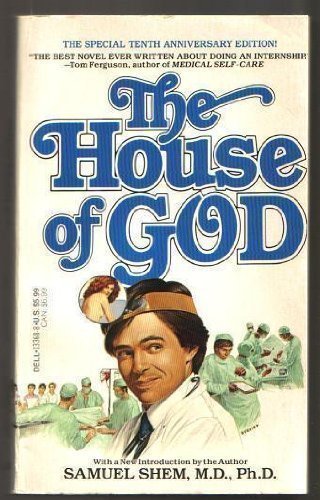
The House of God by Samuel Shem was one of my dad’s favorite books.
He was a kidney transplant surgeon and I think he related to the humorous and cynical perspective on medicine that Samuel Shem expresses in this book.
It starts off very sexy in the introduction… it tones it down as it goes, but sex is ever-present throughout this novel. I’m a bit conflicted because it feels exploitative of women, but it’s also hot. The female characters have some amount of subjectivity and characterization, but they’re also very objectified. It was a little awkward for me at times because it felt like I was reading my dad’s porn (lol).
It contains a lot of dark and disgusting humor which was a lot of fun. There were many moments that made me laugh out loud or gasp in horror.
When I started it, I was hoping for something that would help me understand the medical system a bit better. It gave me a lot of empathy for what doctors go through in internship, but I don’t know if there was much actionable that I could use in figuring out my own health issues. I know doctors are overworked and don’t have enough time to properly think about patients’ issues, so I try to keep it simple for them, but I still get denied testing, referrals, and medications pretty often.
Perhaps I’m asking for things that wouldn’t ultimately be good for me, but sometimes the reasons for denial aren’t the most convincing. I recently had a GI doctor tell me she didn’t want to do an endoscopy for my upper-left abdominal pain and acid reflux because she didn’t want to “put me through that,” despite that endoscopy is not particularly risky or painful (as far as I know). And then my previous GI doctor wouldn’t let me try a new medication for constipation because he said my current medication was “the strongest one,” even though it’s not doing much for me anymore and meds sometimes work differently for different people.
It has me questioning: “What’s the deal with all the medical gatekeeping?”
I was also looking for something that would show me more of my dad’s perspective on medicine. It’s been about six years since he died and I’m starting to feel more nostalgic about him.
Samuel Shem’s perspective on medicine is minimalistic—do as little as possible. This is because testing and treatments can often make patients worse, like the poor lady who got a CT for something else and went into kidney failure because of the contrast dye or the absolute bloodbath of the guy dying of bone cancer and the red-hot doctors insisted on giving him CPR and shattering his ribs.
I’m a little skeptical of medical minimalism because I’m on the other side of the office. I’m here to get something done. I want to figure out what the cause is, not just be brushed off with medications for the symptoms. It’s hard when you have a chronic illness to get doctors to understand how much it’s impacting your life.
I’m currently trying to work on my chronic constipation issue. I’ve had it since I was four years old and we did only acute treatment for it when I was growing up. I didn’t see a gastroenterologist until I was thirty-four. I’m not sure if something like a Miralax regimen would have helped or made it worse in the long run, though.
When I was a kid, I kind of downplayed it 1) because it was embarrassing and 2) because when I was a child I was afraid of getting more treatment than I wanted. Now that I’m an adult I feel more in-control and I’m more willing to tolerate the short-term pain of medical intervention if I think it might lead to long-term relief.
Some of the symptoms motivating me to seek treatment are new. I tried 3 SSRIs in 2020 and those made my constipation much worse… I was told side effects would go away, but they never did. Plus the upper-left abdominal pain started around then too and is very annoying…
Not getting treatment as a kid may have had something to do with my dad’s minimalistic philosophy of care too, though. He seemed to have a toughness to resisting medical treatment or perhaps a skepticism of medical care despite (or because of?) being a doctor. He waited a long time to get a colonoscopy after experiencing symptoms of colon cancer and I don’t really know why.
I did like Samuel Shem’s perspective on death, though. He seems pretty pro-euthanasia (as opposed to dying in excruciating pain). Roy sits with a patient who is a doctor while he’s dying in pain and then… spoilers, but you probably guess what he does with the next patient in the same situation. Very illegal, but kind. I was shocked when I read that.
Euthanasia does seem like the humane choice at a certain point, but there’s something hubristic about humans trying to control the time of death. There’s a certain natural appeal to going out on G-d’s time. And there’s the thorny issue of caretakers pressuring patients into euthanasia… One practical thing to be aware of is that if you think you may want euthanasia, you have to apply for it way in advance (like 1-3 years).
I’m not sure how I feel about the GOMER (Get Out of My Emergency Room) thing. GOMERs are people so advanced in age that they are often reduced to having only one set phrase (things like “Purrty good” or “Get avey!”) and usually require difficult or disgusting procedures like fecal disimpaction. I saw a video from Dr. Glaukomflecken on YouTube about how he doesn’t ever condone making fun of patients (he has a humor channel that often makes fun of doctors and medicine) and the concept of GOMERS is 100% making fun of patients. I think it would be hard for doctors to never make fun of patients, at least in private. I think if I were a doctor, I would have a hard time not laughing at patients at all, especially if they say or do something funny (but maybe it’s a good thing I’m not a doctor lol). I think doctors need a little humor to get through a tough job, and I think that’s a large part of what this book is about.
The bed position joke was a terrible idea, as the novel shows…
I felt really bad for Berry. She’s the psychologist that Roy is dating and every scene with her is just her giving him free therapy. She is the ultimate supportive partner, but I wonder what she’s getting back? Roy is a bad partner in the first book (on top of being emotionally unavailable, he cheats). I started the second book (Man’s 4th Best Hospital, which was published in 2019, 41 years after The House of God which came out in 1978) and he’s not only a bad partner but a bad father (he brings Twinkies and soda for his daughter’s preschool class snack. The teacher was probably thinking, “Are you going to stay and help watch this whole class of preschoolers hopped up on sugar?”), which is really frustrating.
I think the worst part of The House of God is the way the black character (Chuck) keeps advancing through his career by getting mysterious letters in the mail offering him first admission to college and then admission to a medical internship. It’s obviously a comment on affirmative action. On the plus side, Chuck is a really good doctor because he has more practical than academic knowledge, unlike his peers who know a lot of information but struggle with doing procedures.
I also didn’t like how the only female doctor (Jo) is terrible. Her philosophy is the opposite of the Fat Man(Roy’s mentor)’s: do everything for every patient. This leads to worse outcomes. Roy and the other interns decide to do as little as possible and tell her they did everything. Suddenly the patients start doing better, but because they lied to her, she thinks it was due to her philosophy of doing everything. Jo exemplifies a sad case of a doctor for whom being a doctor is all she has—she doesn’t have any hobbies or friends outside of the hospital and doesn’t get along with the other doctors at the hospital. I think she doesn’t allow herself to hang out with Roy and Chuck because she thinks they’re slacking off, but she needs to find a way to relax so that she doesn’t get depressed and burnt out.
With the sex, I did get a little worried that it might give new doctors the impression that nurses are available for sex. I doubt things in real life are like they are in the book. It does have a fantastic aspect to the descriptions that I think instills some measure of doubt in the reader, but for younger readers, I’d be a little worried that it might influence them to sexually harass their coworkers.
This is another book, like The Invention of Solitude, that surprised me with how Jewish it was. I knew the author and the main character were Jewish, but the main character’s mentor and many of the interns are also Jewish. The sexy Jewish joke the Irish policeman told and also the way they painted the doorposts red when there was an “Angel of Death” looming over the ICU were hilarious!
I think that’s most of what I have to say about The House of God. I would definitely recommend it to anyone with a dark or gross sense of humor or anyone who’s curious about what it’s like to train to be a doctor. I don’t know if I would recommend it to people who are trying to learn more about how our current medical system works, it might be a little outdated and it doesn’t really go into detail about important things like insurance or liability. Man’s 4th Best Hospital might go into that more, and I’ll be sure to review that if or when I finish it.


Leave a Reply to S.B. HowellCancel reply